
The attention is already here
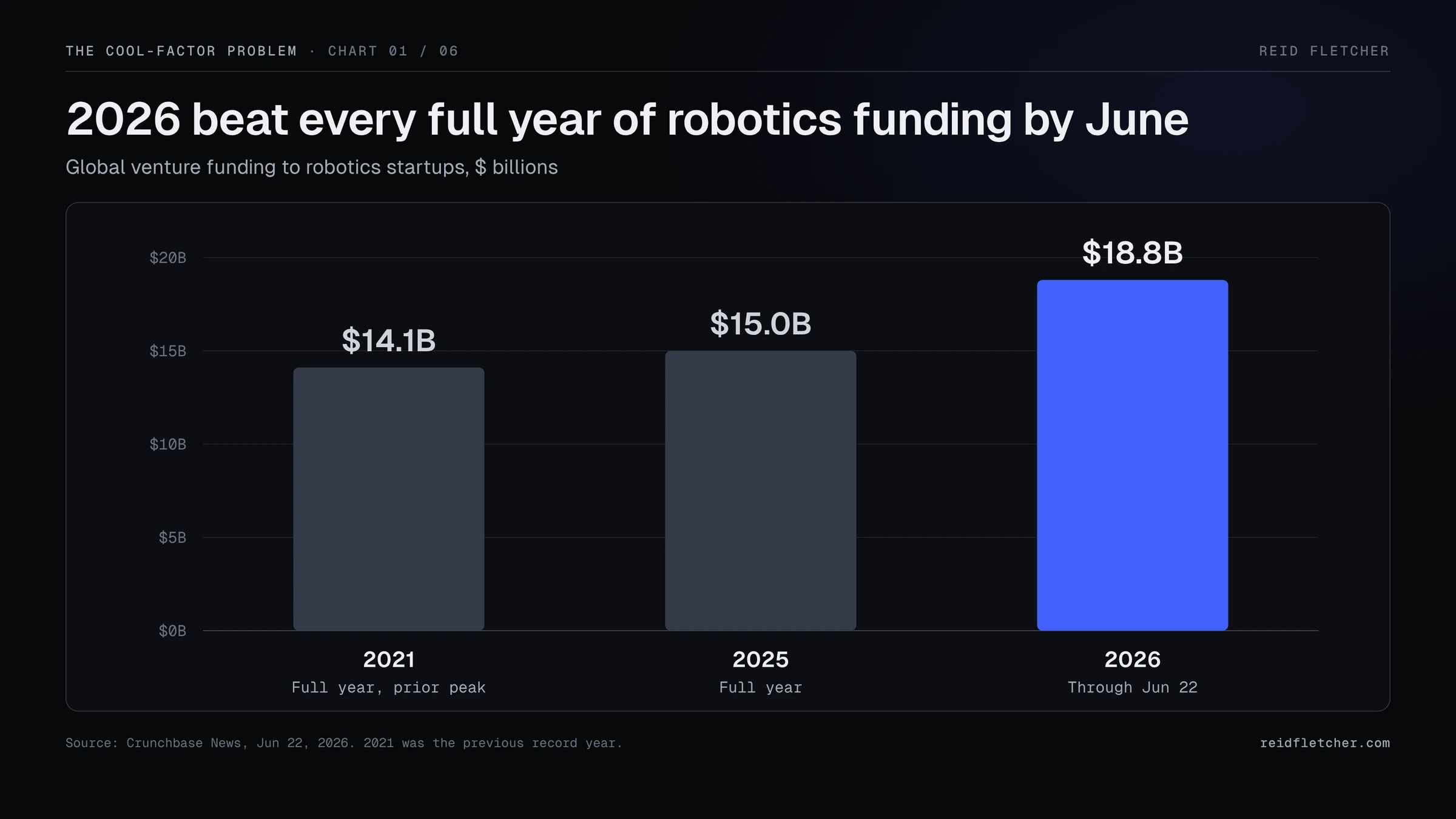
Nobody has to be told a robot is cool. The money already knows. By June 22, robotics startups had raised $18.8 billion in 2026, more than in all of 2025 ($15 billion) and more than in 2021, the previous peak ($14.1 billion), according to Crunchbase.
So attention isn’t the bottleneck. Understanding is. Most people still can’t say what a robot will do for them, when, or how reliably. That gap is measurable, and the numbers below explain it: three technical truths, and the one number every robotics story should lead with.
People want the chores done, but they don’t trust the robot yet
Ask people what a robot is for and the answers are specific. In a YouGov survey of 1,247 U.S. adults (January 2025), 38% said they’d be interested in a household robot. Of the tasks YouGov asked about, the top three were cleaning floors (93%), washing dishes (87%) and laundry (86%).
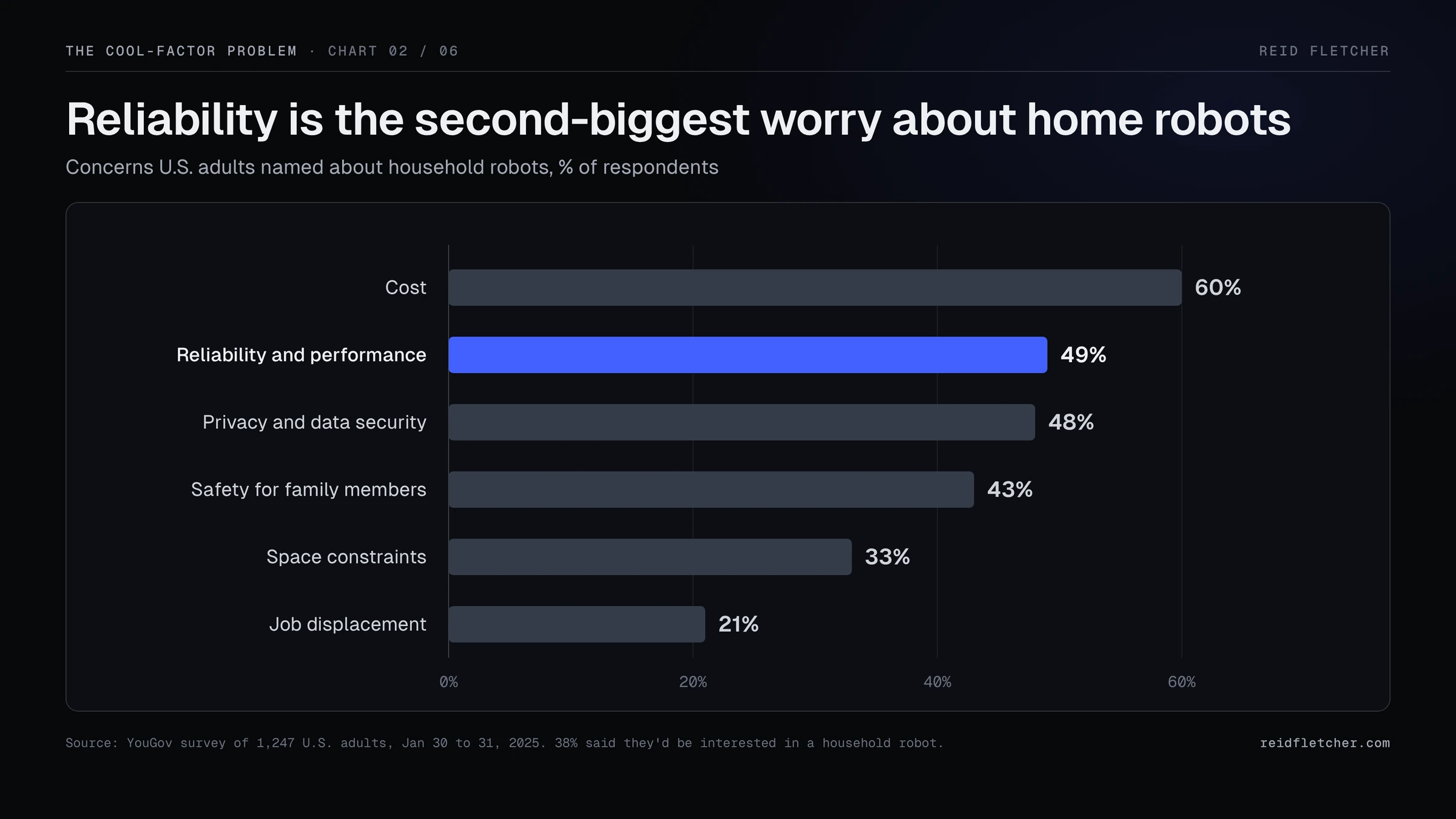
The concerns respondents named are just as specific. Cost came first at 60%. Reliability and performance came second at 49%, ahead of privacy (48%) and safety (43%). Job displacement was last, at 21%.
Adoption is still early. In Pew’s February 2026 survey, 13% of Americans said they own a robot vacuum with AI features.
People aren’t asking for a cooler robot. They’re asking whether it will work every time, and whether it’s worth the money.
Truth 1: reliability compounds
A demo shows one success. A job is a chain of steps, and every step has to work.
And the steps are the hard part. Moravec’s paradox, from the 1980s, still holds: the reasoning people find hard is comparatively easy for machines, while the perception and dexterity a toddler has are among the hardest things to build.
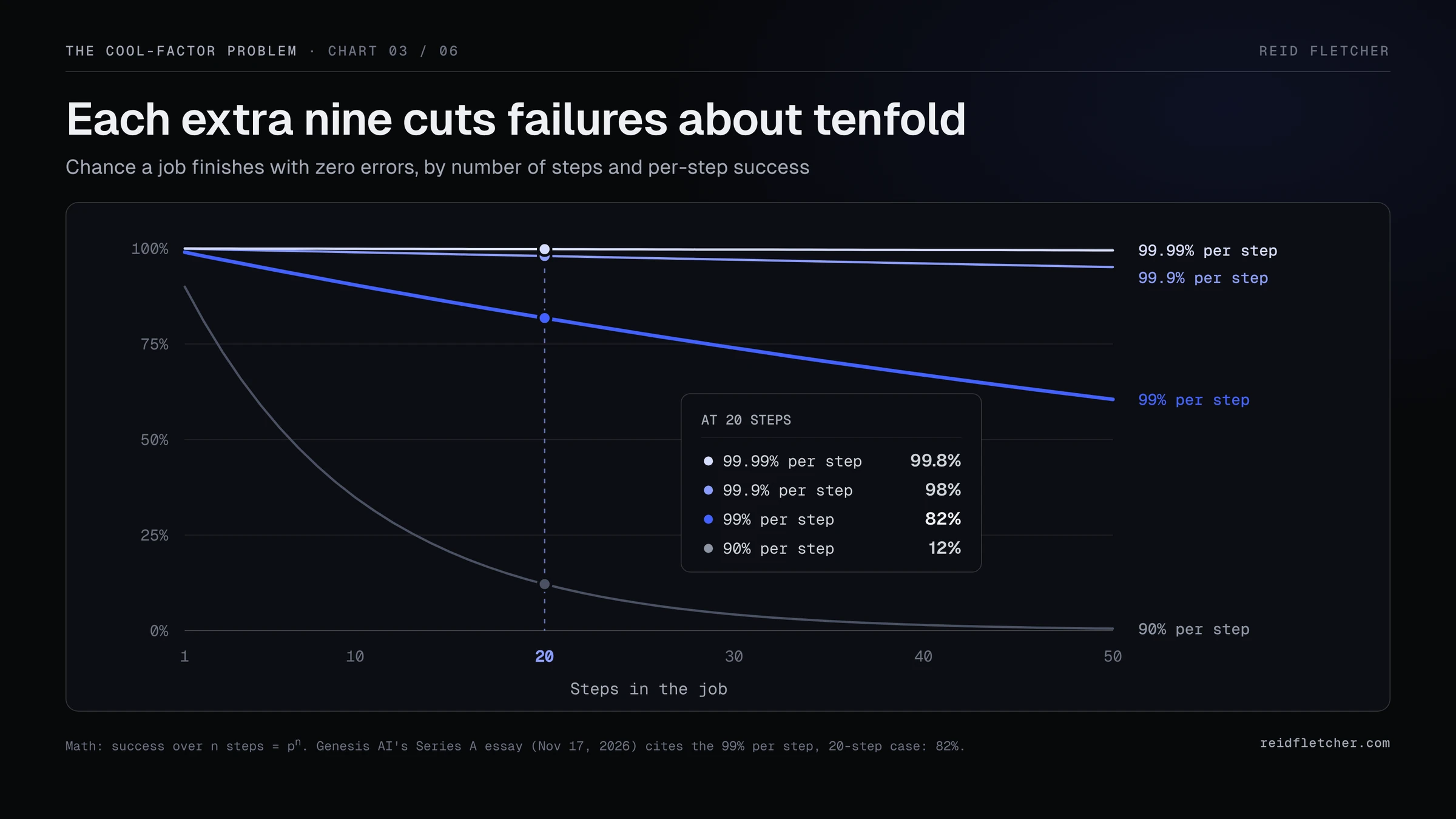
If each step succeeds with probability p, a job of n steps succeeds with probability pⁿ. Genesis AI put it plainly in its Series A essay this week: a robot that gets each step right 99% of the time has only an 82% chance of finishing a 20-step workflow without an error.
Now run that 20-step job 1,000 times.
At 99% per step, about 182 of those runs hit an error. At 99.9%, about 20. At 99.99%, about 2. At 90%, almost nine in ten fail.
pⁿ is the worst case: a robot that never notices its own mistakes. If it can detect a failed step and retry, the math changes. Give a 99% step one reliable retry and its effective success becomes 1 − 0.01², or 99.99%. That’s two extra nines, and the 20-step job goes from 82% to 99.8%.
The catch is that real failures aren’t independent. A bad grasp setup tends to fail the same way twice, and some misses can’t be retried: a dropped glass stays dropped. So the honest number is per-step success after recovery.
Either way, each extra nine cuts failures about tenfold. That’s why “it works” means little in robotics until someone says how often, over how many steps, and with how many human interventions. Self-driving learned this through miles per disengagement. Manipulation needs its own version: interventions per hour on a real shift.
Truth 2: robots are data-starved
Language models learned from the internet. Robots have no internet of physical skill to learn from, so every hour of training data has to be collected.
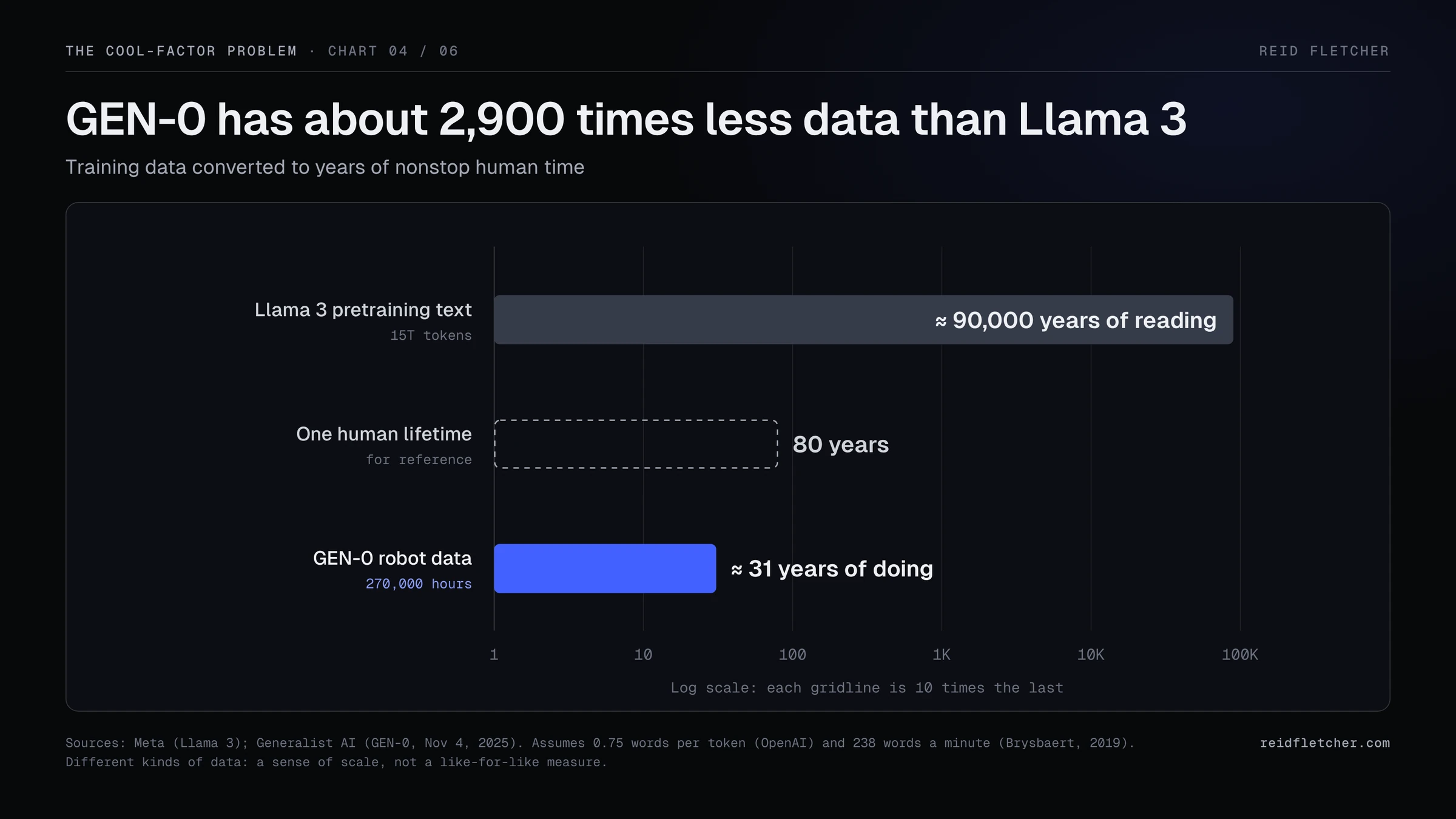
The scale gap is enormous. Meta pretrained Llama 3 on over 15 trillion tokens. At about three-quarters of a word per token and an average reading speed of 238 words a minute, that’s roughly 90,000 years of nonstop human reading.
Generalist AI’s GEN-0, one of the largest real-world manipulation datasets disclosed, was trained on over 270,000 hours of robot data. That’s about 31 years of nonstop doing: about 2,900 times less than the text side. At the 10,000 new hours a week Generalist reports, closing that gap would take about 1,500 years, although the company says its pace is accelerating.
Reading and doing are different kinds of data, so this is a sense of scale, not a like-for-like comparison. But it explains where the industry’s money is going: data gloves, teleoperation fleets and simulation all exist to manufacture experience faster. Generalist’s own results show why it matters. Its models only started absorbing large-scale robot data at around 7 billion parameters.
Above that size, Generalist reports a power law between pretraining data and downstream performance: more data predictably buys a better robot. It’s the same kind of scaling signal that drove the language-model race.
Hours also aren’t interchangeable. Data from one robot body doesn’t transfer cleanly to another with different joints, hands or cameras. The Open X-Embodiment project pooled data from 22 different robots across 21 institutions and found positive transfer, but the gap is real, and it’s why labs build hardware to match their data. Genesis AI’s data glove, for example, is designed for a 1:1:1 mapping between the glove, the person’s hand and the robot hand.
Truth 3: the robots that ship do one job well
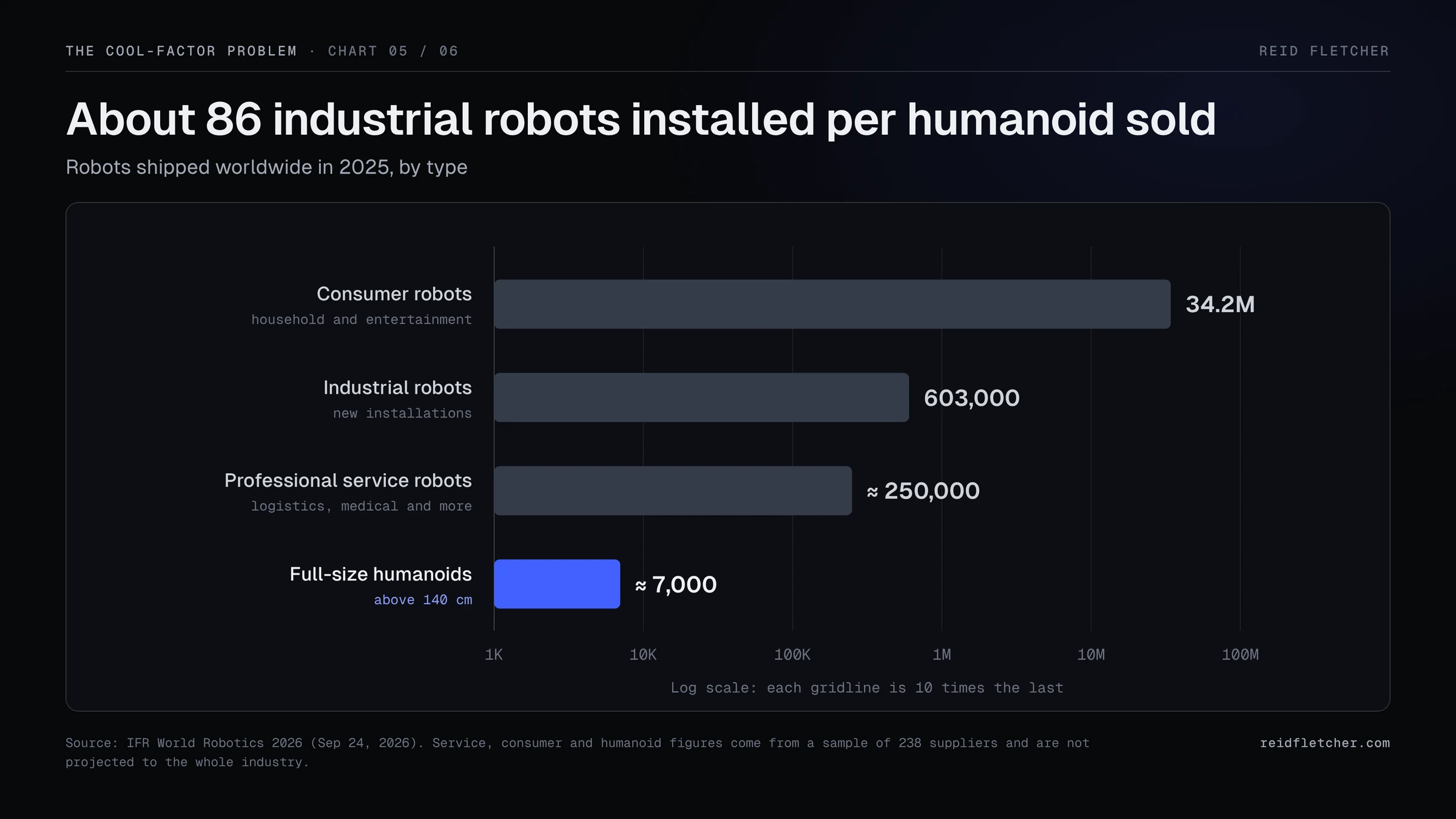
The robots already at work aren’t the ones in the viral clips. The International Federation of Robotics’ World Robotics 2026 report counts:
- 603,000 industrial robots installed in 2025, up 11% and past 600,000 for the first time. The global fleet hit a record 5 million.
- 354,000 of those installs (59%) were in China. The U.S. was second at almost 38,500.
- Almost 250,000 professional service robots shipped, led by transport and logistics (117,500).
- About 34.2 million consumer robots sold, largely single-task household machines like floor cleaners.
- About 7,000 full-size humanoids.
That’s roughly 86 industrial robots installed for every full-size humanoid sold. The deployed fleet is arms bolted to a cell, carts moving totes, vacuums mapping a floor. Each one does one job, thousands of times, inside a known space. That’s how they reached the nines.
General-purpose robots have to earn the same trust in messier places. The funding says investors believe they will. The deployment numbers say the proof is still being built.
Why it matters: the hours
Here’s the number that should lead every robotics story: time.
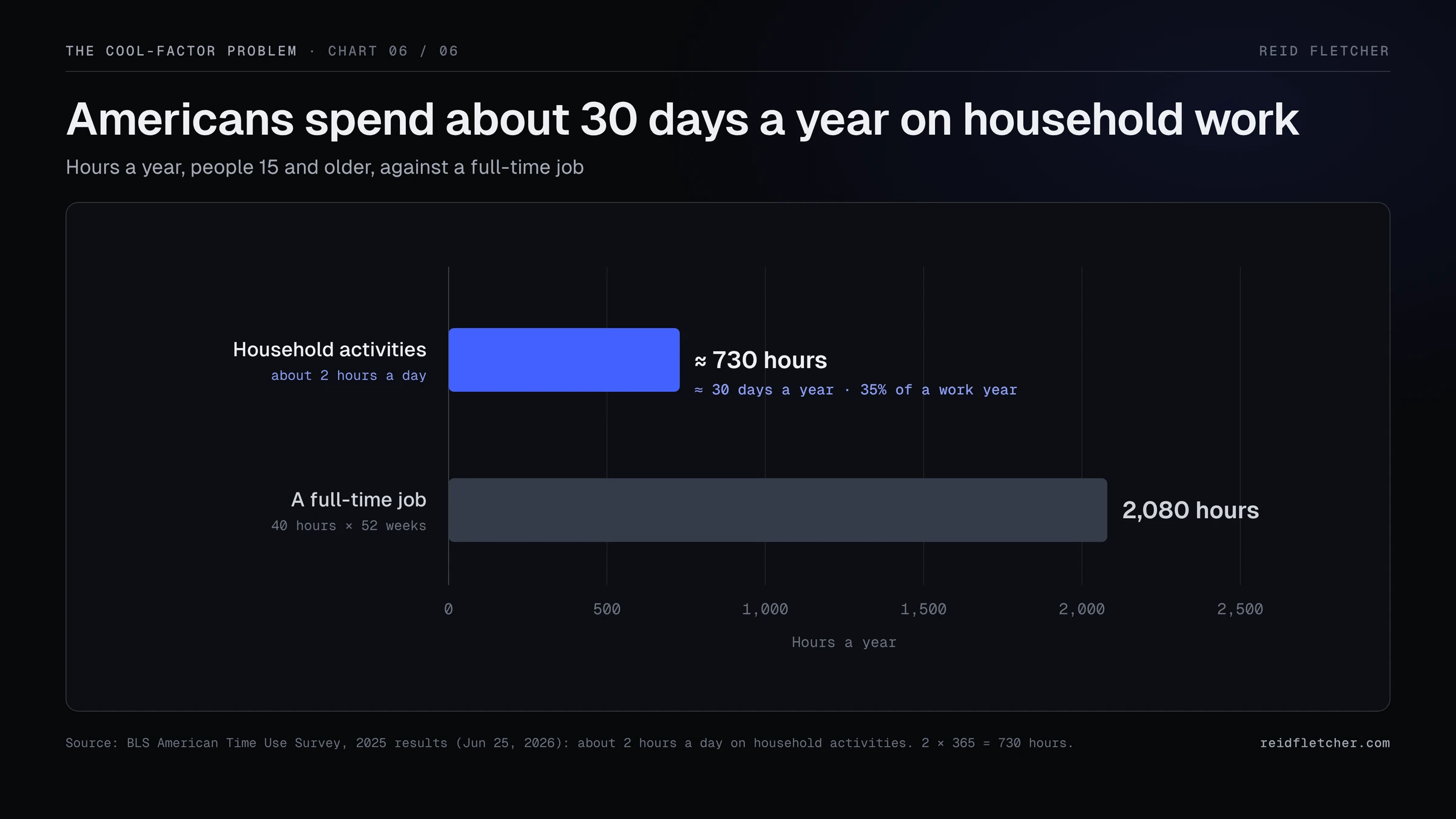
The Bureau of Labor Statistics’ American Time Use Survey (2025 data, released June 25, 2026) found that Americans 15 and older spend about 2 hours a day on household activities, and 81% do some every day. That’s about 730 hours a year: roughly 30 full days, or 35% of a full-time work year, unpaid.
Work has the same math at a bigger scale. Deloitte and the Manufacturing Institute estimate U.S. manufacturing could need as many as 3.8 million new workers between 2024 and 2033, and 1.9 million of those jobs could go unfilled.
That’s the why-it-matters story. A robot that folds laundry is a cool clip. A robot that gives a family back 30 days a year, or covers a shift nobody can staff, is a reason to care.
What fixes the story
The data points to four habits for anyone telling robotics stories, founders included:
- Lead with the hours. Say what the robot gives someone: time back at home, a shift covered, a task nobody wants. Put the investor’s number second.
- Publish the nines. Per-step success, steps per task, interventions per hour, hours on a real shift. One number with its denominator beats a montage.
- Label the footage. Autonomous or teleoperated, playback speed, where the cuts are. Researchers check, and the ones who check are the ones who share.
- Show a full shift. An unbroken run of real work proves more than a backflip.
The industry already has the attention. The companies that show their nines and count the hours will turn it into trust.
Sources and method
- Crunchbase News, “Robotics Startups On Fire As Venture Funding Surges To Record Numbers In 2026”, Jun 22, 2026
- YouGov, “Two in five Americans are interested in having a household robot”, 1,247 U.S. adults, Jan 30 to 31, 2025. The article doesn’t state the base for the task and concern questions.
- Pew Research Center, “Americans and AI 2026”, 5,119 U.S. adults, Feb 17 to 23, 2026
- Genesis AI, Series A essay, Nov 17, 2026
- Meta, “Introducing Meta Llama 3”: pretrained on over 15T tokens
- OpenAI Help Center, “What are tokens and how to count them?”: 1 token is about 3/4 of a word
- Brysbaert, “How many words do we read per minute?”, 2019 meta-analysis of 190 studies: 238 words a minute (preprint)
- Generalist AI, “GEN-0”, Nov 4, 2025: over 270,000 hours, growing 10,000 hours a week
- International Federation of Robotics, World Robotics 2026, Sep 24, 2026; fleet of 5 million. Service robot figures come from a sample of 238 suppliers.
- U.S. Bureau of Labor Statistics, American Time Use Survey, 2025 results, Jun 25, 2026
- Deloitte and the Manufacturing Institute, 3.8 million workers needed by 2033, Apr 3, 2024
- Open X-Embodiment Collaboration, “Open X-Embodiment: Robotic Learning Datasets and RT-X Models”, 2023: 22 robots, 21 institutions, positive transfer
- The Robot Report, “Genesis AI introduces GENE foundation model”, May 6, 2026: the glove’s 1:1:1 mapping
- Hans Moravec, Mind Children, 1988: the paradox, as it’s usually summarized
Method. Job success = (per-step success)^20. Years of reading = 15 trillion tokens × 0.75 words ÷ 238 words a minute, around the clock. Robot data years = 270,000 hours ÷ 8,760. Household hours = 2 a day × 365. Work year = 40 hours × 52 weeks = 2,080.